
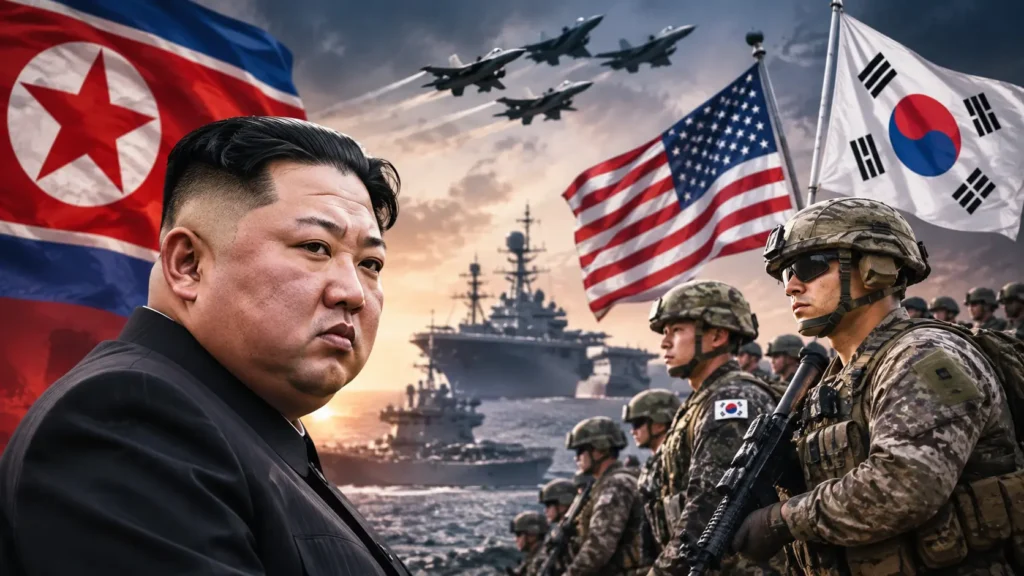
North Korea cautioned (warned, alerted, forewarned) on Friday that it might retaliate (respond, hit back, counter) with “a new level of deterrent (restraint, dissuasion, curb)” against the forthcoming joint military manoeuvres (drills, exercises, operations) between the United States and South Korea. These manoeuvres (drills, exercises, operations) are designed to simulate (mimic, replicate, imitate) combat against North Korean forces that have grown battle-hardened (seasoned, war-tested, combat-toughened) through their deployment (posting, dispatch, stationing) in the Russia-Ukraine conflict.
The eleven-day (11-day) exercises, set to commence (begin, start, get underway) on Monday, form a recurring (annual, regular, periodic) part of the summer schedule. They are intended (meant, designed, aimed) to equip (prepare, ready, train) the United States and South Korea to defend (guard, protect, shield) against the nuclear-armed (nuclear-capable, atomic-equipped) North.
Pyongyang habitually (regularly, routinely, consistently) describes these drills as rehearsals (practice runs, preparations, trial exercises) for an invasion, and this week it launched (fired, test-fired, discharged) a ballistic missile over the Sea of Japan — a move signalling its opposition (resistance, disapproval, defiance) to the exercises.
However, this year’s drills have been tailored (adapted, customised, fine-tuned) to prepare soldiers to fight North Koreans equipped with modern combat expertise (experience, proficiency, skill) gained from the Russia-Ukraine theatre (arena, battleground, war zone) — including capabilities in drone warfare, cyber-attacks, and GPS jamming (signal disruption, satellite interference).
“The US has announced (declared, stated, disclosed) that the upcoming exercises differ substantially (are markedly different, diverge greatly) from those of the past five years, and are intended to master (perfect, refine, hone) the ability to fight a war based on the new facets (aspects, dimensions, features) of modern warfare,” said a spokesman (representative, spokesperson, official) for North Korea’s Foreign Ministry.
“It is our steadfast (consistent, unwavering, firm) principle of safeguarding (ensuring, securing, protecting) our security to counter a new level of menace (threat, danger, hazard) with a new level of deterrent (restraint, dissuasion, curb),” the statement continued, as published by North Korea’s Korean Central News Agency.
North Korea has long held a reputation (standing, image, name) as one of the most isolated (cut-off, secluded, insular) nations on Earth.
Yet since Russia launched its full-scale invasion of Ukraine in 2022, North Korea has emerged as a pivotal (key, crucial, central) ally (partner, associate, supporter) to the Kremlin — sending troops to bolster its faltering (struggling, weakening, flagging) war effort in exchange for economic incentives (benefits, rewards, advantages) and military technological support, according to analysts (experts, observers, commentators).
This week, Ukraine alleged (accused, claimed, asserted) that Moscow had launched North Korean ballistic missiles in a strike that claimed (killed, took the lives of) at least nine people and injured (wounded, hurt, harmed) dozens more.
Kyiv has also recently claimed that up to 50,000 North Korean troops are due to be deployed (dispatched, sent, stationed) in Russia, although it has offered no evidence (proof, substantiation, corroboration) to support this assertion (claim, allegation, statement).
Lessons Learned From the Battlefield
Colonel Ryan Donald, spokesman (representative, spokesperson, official) for the US and South Korean Combined Forces Command, stated this week that North Korea’s involvement (participation, engagement, role) in the European war had altered (changed, transformed, shifted) the nature of the threat his soldiers might encounter (face, confront, meet) on the Korean peninsula.
“They have absorbed (taken, learned, internalised) the lessons they gained there and brought them back to North Korea,” he told journalists (reporters, correspondents, the press).
“Our training takes into account (accounts for, considers, allows for) that threat.”
Pyongyang’s foreign ministry statement noted that the US-South Korea drills are taking place “at a time when the military and political climate (situation, environment, circumstances) is growing more grave (serious, severe, dire) with each passing day in Europe, the Middle East, and other regions of the world”.
The “Ulchi Freedom Shield” exercises will involve (include, incorporate, comprise) 18,000 South Korean troops alongside counterparts (equivalents, peers) from the 28,500-strong US contingent (force, unit, troop presence) stationed in the country.
Hong Min, a senior (leading, high-ranking, veteran) researcher (analyst, scholar, investigator) at the Korea Institute for National Unification, observed that despite voicing threats of escalation (intensification, aggravation, heightening), the North Korean foreign ministry’s statement was notably restrained (measured, subdued, controlled) in tone.
“The content is not particularly provocative (inflammatory, incendiary, antagonistic). It is quite matter-of-fact (straightforward, plain, factual),” Hong told AFP, adding that Pyongyang may wish to preserve (keep open, maintain, retain) the possibility of future engagement (dialogue, interaction, diplomacy) with Washington.
Pyongyang has repeatedly (persistently, continually, time and again) declared itself an “irreversible (permanent, unalterable, immutable)” nuclear state since leader Kim Jong Un’s 2019 summit (meeting, conference, talks) with US President Donald Trump collapsed (fell apart, broke down, disintegrated) over the scope (extent, range, breadth) of denuclearisation (nuclear disarmament) and sanctions relief (easing of penalties).
It has recently been bristling (fuming, seething, taking offence) over Japan’s gradual (steady, incremental, progressive) military build-up (expansion, reinforcement, strengthening) in the Pacific — firing off two missiles within as many weeks after Tokyo pledged (promised, vowed, committed) to enhance (boost, strengthen, upgrade) its defence capabilities with a “sense of urgency (immediacy, pressing need) and crisis”.
Meanwhile, Victor Cha, Korea Chair at the Center for Strategic and International Studies, stated on Thursday that North Korean leader Kim Jong Un may pursue (seek, look for, aim for) a meeting with US President Donald Trump — potentially after the US midterm elections (mid-term polls).