
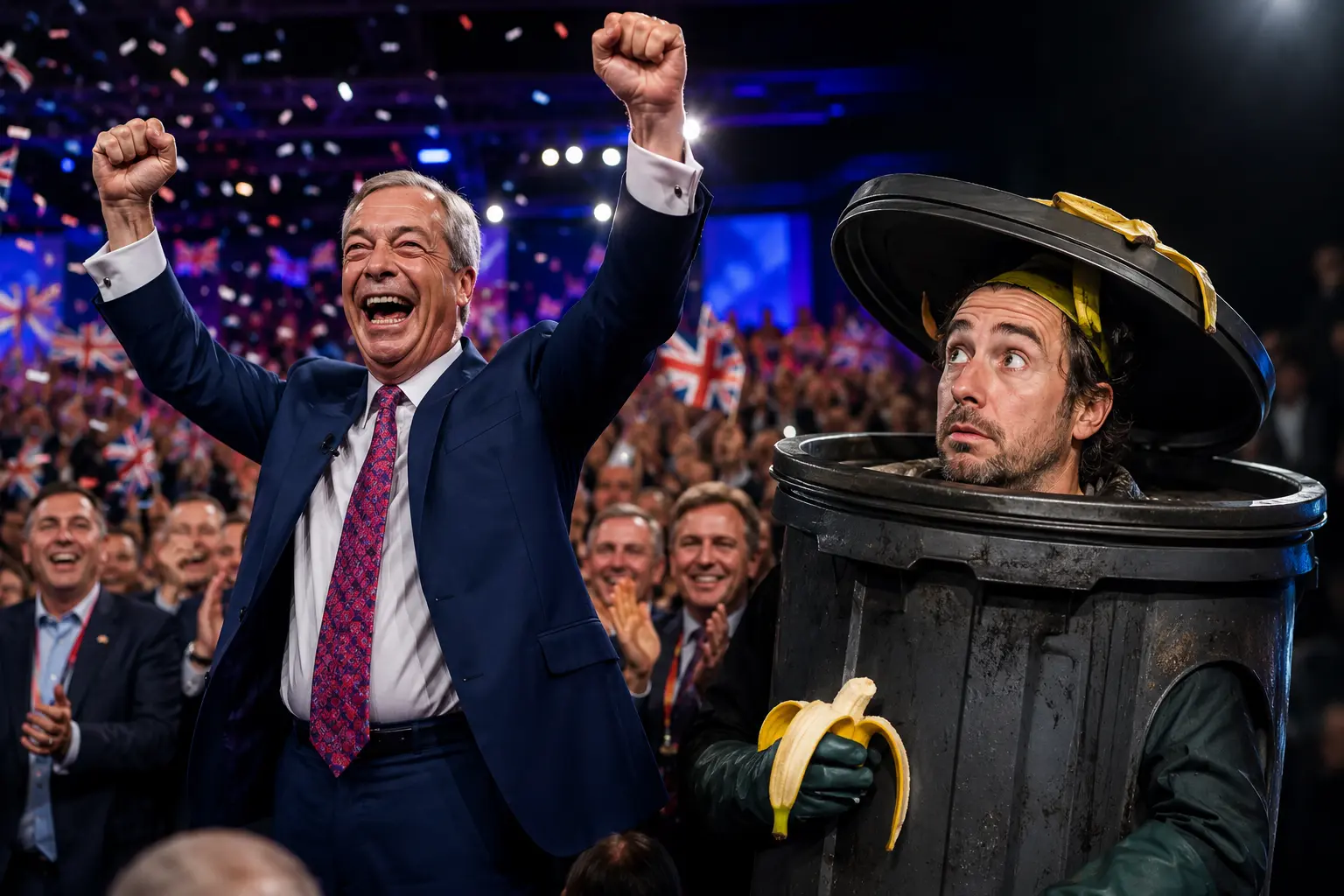
Reform UK leader Nigel Farage has reclaimed (regained, recovered, won back) his parliamentary seat on Friday, in an election he himself triggered (set off, initiated, brought about) in order to bolster (strengthen, reinforce, shore up) his standing against claims of financial impropriety (misconduct, wrongdoing, dishonesty). However, his plan was undermined (weakened, sabotaged, damaged) when his chief rival — a comedian dressed as a rubbish bin — took more than a quarter of the votes cast. Farage, one of Britain’s most prominent Brexit campaigners, in an unusual departure (deviation, break, shift) from normal practice, did not attend the vote count in the seaside town of Clacton in southern England. He claimed police had warned him of a plot to disrupt (interfere with, obstruct, throw into disorder) the result. “I am damned if I am going to stand on a stage, having won a resounding victory … and be demeaned (degraded, belittled, humiliated) and humiliated by nobodies,” Farage told his supporters at a party held before the results were made public. The election came about after Farage stepped down from parliament last month, seeking a fresh mandate (authorisation, approval, sanction) from voters in what he called a battle against an establishment (ruling class, elite, power structure) determined to discredit (disgrace, undermine the reputation of, tarnish) him over undeclared gifts from donors. Once Britain’s main political parties withdrew from the contest, dismissing it as a self-serving (self-interested, opportunistic, egotistical) stunt (publicity trick, gimmick, ploy), Farage’s principal opponent turned out to be Count Binface — a character invented by comedian Jonathan Harvey, who has become a well-known figure of light relief at British elections. Farage secured 62.8 per cent of the vote, while Count Binface — whose manifesto included capping ice cream prices and conscripting (forcibly enlisting, drafting, recruiting) anyone caught using a speakerphone on public transport — won 26.7 per cent. Reform’s Momentum Begins to Fade Having enjoyed a long-standing lead in opinion polls, Reform’s popularity has begun to wane (decline, diminish, fade), partly due to the funding allegations (accusations, claims, charges) against Farage. He is currently under parliamentary investigation over whether he ought to have declared a £5 million ($6.75m) gift from a cryptocurrency billionaire. After he described the Clacton election as little more than a ploy (scheme, tactic, manoeuvre) to divert attention from these allegations, other parties’ withdrawal left even some loyal supporters wondering whether the seasoned politician had been wrong-footed (caught off guard, outmanoeuvred, tripped up). Laura Richards-Gray, a politics lecturer at Birkbeck University in London, observed that the absence of major-party rivals undermined (weakened, sabotaged, damaged) his attempt to frame the contest as “the people versus the establishment.” “This has backfired (gone wrong, rebounded negatively, misfired), particularly on a national scale, as Farage lost control of the narrative (storyline, account, framing),” she said, adding that some voters regarded the election as “a waste of time and money.” Farage’s standing has also suffered from rising support for the governing Labour Party. Since Andy Burnham became prime minister last month, Labour has enjoyed a bounce (surge, upswing, boost) in the ratings, now leading Reform 28 per cent to 25 per cent. Burnham has dominated (controlled, commanded, been at the forefront of) the airwaves and social media during his first weeks in office and, although the next general election is not expected for three years, he appears to be consolidating (strengthening, unifying, cementing) a left-leaning coalition around Labour. Reform, meanwhile, finds itself competing for a divided (split, fragmented, fractured) right-wing vote, with both the Conservative Party and the anti-immigration party Restore Britain gaining ground. The Billionaire’s Gift Under Scrutiny Despite this electoral win, the parliamentary watchdog is expected to press on with its inquiry (investigation, probe, examination) into Farage’s financial declarations once he takes up his seat again. Central to the investigation is whether he should have disclosed the gift from a Thailand-based billionaire ahead of the 2024 general election. Under parliamentary rules, MPs must declare any donations received in the year before an election within one month of taking office. Farage has admitted to receiving the money but not declaring it, insisting he has done nothing improper since it was a personal gift. Should the investigating authorities determine that Farage breached (violated, broke, contravened) the declaration rules, he could face suspension (temporary removal, expulsion, exclusion) from parliament — and yet another vote to keep his seat, one in which the major parties would likely field candidates this time.
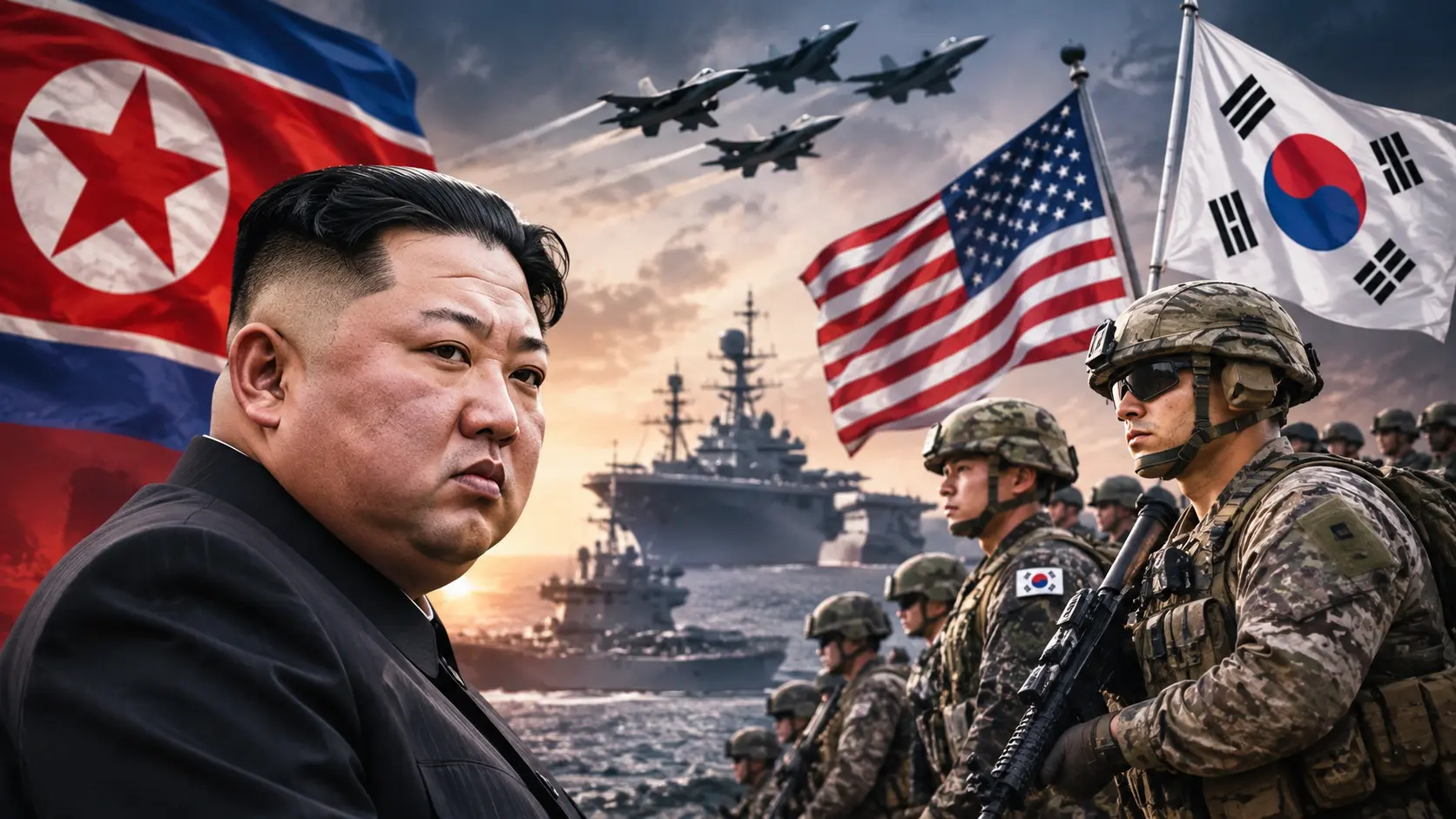
North Korea Cautions Against Joint US–South Korea Military Drills
North Korea cautioned (warned, alerted, forewarned) on Friday that it might retaliate (respond, hit back, counter) with “a new level of deterrent (restraint, dissuasion, curb)” against the forthcoming joint military manoeuvres (drills, exercises, operations) between the United States and South Korea. These manoeuvres (drills, exercises, operations) are designed to simulate (mimic, replicate, imitate) combat against North Korean forces that have grown battle-hardened (seasoned, war-tested, combat-toughened) through their deployment (posting, dispatch, stationing) in the Russia-Ukraine conflict. The eleven-day (11-day) exercises, set to commence (begin, start, get underway) on Monday, form a recurring (annual, regular, periodic) part of the summer schedule. They are intended (meant, designed, aimed) to equip (prepare, ready, train) the United States and South Korea to defend (guard, protect, shield) against the nuclear-armed (nuclear-capable, atomic-equipped) North. Pyongyang habitually (regularly, routinely, consistently) describes these drills as rehearsals (practice runs, preparations, trial exercises) for an invasion, and this week it launched (fired, test-fired, discharged) a ballistic missile over the Sea of Japan — a move signalling its opposition (resistance, disapproval, defiance) to the exercises. However, this year’s drills have been tailored (adapted, customised, fine-tuned) to prepare soldiers to fight North Koreans equipped with modern combat expertise (experience, proficiency, skill) gained from the Russia-Ukraine theatre (arena, battleground, war zone) — including capabilities in drone warfare, cyber-attacks, and GPS jamming (signal disruption, satellite interference). “The US has announced (declared, stated, disclosed) that the upcoming exercises differ substantially (are markedly different, diverge greatly) from those of the past five years, and are intended to master (perfect, refine, hone) the ability to fight a war based on the new facets (aspects, dimensions, features) of modern warfare,” said a spokesman (representative, spokesperson, official) for North Korea’s Foreign Ministry. “It is our steadfast (consistent, unwavering, firm) principle of safeguarding (ensuring, securing, protecting) our security to counter a new level of menace (threat, danger, hazard) with a new level of deterrent (restraint, dissuasion, curb),” the statement continued, as published by North Korea’s Korean Central News Agency. North Korea has long held a reputation (standing, image, name) as one of the most isolated (cut-off, secluded, insular) nations on Earth. Yet since Russia launched its full-scale invasion of Ukraine in 2022, North Korea has emerged as a pivotal (key, crucial, central) ally (partner, associate, supporter) to the Kremlin — sending troops to bolster its faltering (struggling, weakening, flagging) war effort in exchange for economic incentives (benefits, rewards, advantages) and military technological support, according to analysts (experts, observers, commentators). This week, Ukraine alleged (accused, claimed, asserted) that Moscow had launched North Korean ballistic missiles in a strike that claimed (killed, took the lives of) at least nine people and injured (wounded, hurt, harmed) dozens more. Kyiv has also recently claimed that up to 50,000 North Korean troops are due to be deployed (dispatched, sent, stationed) in Russia, although it has offered no evidence (proof, substantiation, corroboration) to support this assertion (claim, allegation, statement). Lessons Learned From the Battlefield Colonel Ryan Donald, spokesman (representative, spokesperson, official) for the US and South Korean Combined Forces Command, stated this week that North Korea’s involvement (participation, engagement, role) in the European war had altered (changed, transformed, shifted) the nature of the threat his soldiers might encounter (face, confront, meet) on the Korean peninsula. “They have absorbed (taken, learned, internalised) the lessons they gained there and brought them back to North Korea,” he told journalists (reporters, correspondents, the press). “Our training takes into account (accounts for, considers, allows for) that threat.” Pyongyang’s foreign ministry statement noted that the US-South Korea drills are taking place “at a time when the military and political climate (situation, environment, circumstances) is growing more grave (serious, severe, dire) with each passing day in Europe, the Middle East, and other regions of the world”. The “Ulchi Freedom Shield” exercises will involve (include, incorporate, comprise) 18,000 South Korean troops alongside counterparts (equivalents, peers) from the 28,500-strong US contingent (force, unit, troop presence) stationed in the country. Hong Min, a senior (leading, high-ranking, veteran) researcher (analyst, scholar, investigator) at the Korea Institute for National Unification, observed that despite voicing threats of escalation (intensification, aggravation, heightening), the North Korean foreign ministry’s statement was notably restrained (measured, subdued, controlled) in tone. “The content is not particularly provocative (inflammatory, incendiary, antagonistic). It is quite matter-of-fact (straightforward, plain, factual),” Hong told AFP, adding that Pyongyang may wish to preserve (keep open, maintain, retain) the possibility of future engagement (dialogue, interaction, diplomacy) with Washington. Pyongyang has repeatedly (persistently, continually, time and again) declared itself an “irreversible (permanent, unalterable, immutable)” nuclear state since leader Kim Jong Un’s 2019 summit (meeting, conference, talks) with US President Donald Trump collapsed (fell apart, broke down, disintegrated) over the scope (extent, range, breadth) of denuclearisation (nuclear disarmament) and sanctions relief (easing of penalties). It has recently been bristling (fuming, seething, taking offence) over Japan’s gradual (steady, incremental, progressive) military build-up (expansion, reinforcement, strengthening) in the Pacific — firing off two missiles within as many weeks after Tokyo pledged (promised, vowed, committed) to enhance (boost, strengthen, upgrade) its defence capabilities with a “sense of urgency (immediacy, pressing need) and crisis”. Meanwhile, Victor Cha, Korea Chair at the Center for Strategic and International Studies, stated on Thursday that North Korean leader Kim Jong Un may pursue (seek, look for, aim for) a meeting with US President Donald Trump — potentially after the US midterm elections (mid-term polls).