
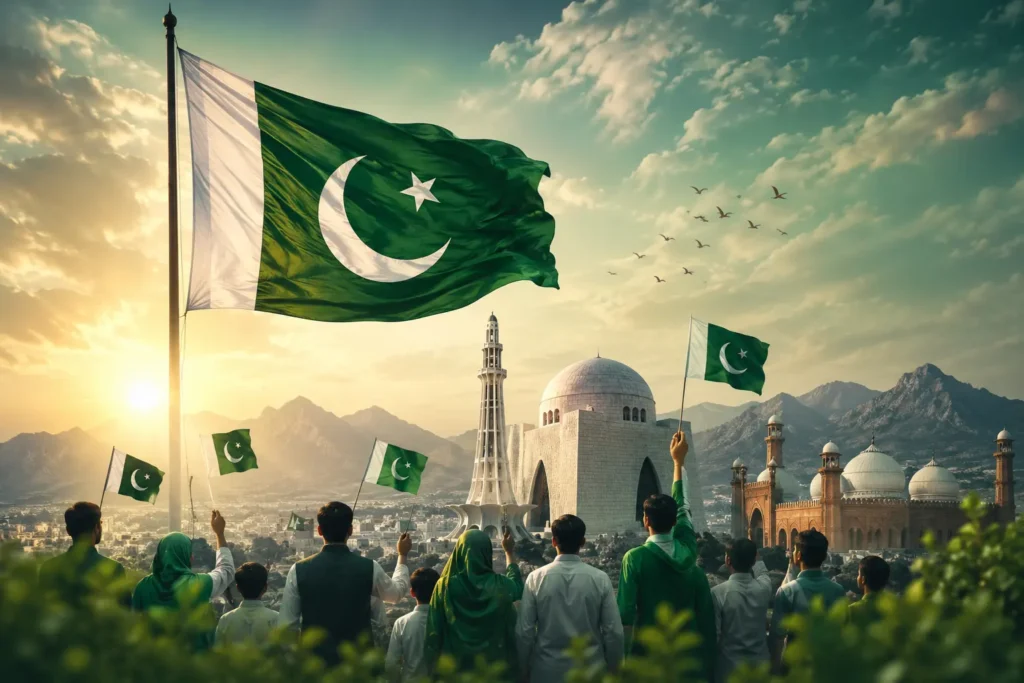
On the 79th anniversary (milestone, jubilee) of independence, Pakistan’s civil and armed forces chiefs called for solidarity (togetherness, unity) and structural reforms (policy changes, restructuring) to move the country forward.
State broadcaster Radio Pakistan reported that celebrations kicked off with a 31-gun salute (ceremonial gunfire, honorary volley) in the capital and a 21-gun salute at provincial capitals, whilst a guard-changing ritual took place at Quaid-i-Azam’s mausoleum (tomb, shrine) in Karachi.
President Zardari’s Message
President Asif Ali Zardari honoured (paid tribute to, commended) the founders of Pakistan and those who relinquished (gave up, sacrificed) their homes and safety during the freedom struggle. He remarked that independence isn’t merely a milestone (landmark, achievement) from the past but an ongoing duty (obligation, responsibility) that every generation must carry forward, adding that the nation built through public will must keep advancing toward greater strength, security and prosperity (economic wellbeing, affluence).
He noted that the past twelve months had reaffirmed (confirmed again, reasserted) the nation’s collective resilience (fortitude, toughness). Referring to last year’s short-lived clash (conflict, skirmish) with India, dubbed Marka-i-Haq, he stated that Pakistan seeks peace, but also possesses the resolve and capacity (determination, self-governance) to protect its sovereignty and national interests. He described strength as inseparable from responsibility, saying a nation capable of self-defence must also use that power to avert (prevent, forestall) conflict and safeguard peace.
The president acknowledged that today’s stability came at a steep price, honouring soldiers, police and law-enforcement personnel who lost their lives, crediting their bravery for shielding the country from external aggression (outside attack, foreign hostility) and terrorism.
He also pointed to Pakistan’s diplomatic efforts, noting that its geographic position and communication channels had helped promote dialogue and de-escalation (easing tension, calming down) during moments when broader conflict could have harmed the whole region. He reaffirmed that disputes should ultimately be resolved through diplomacy, adding that Pakistan’s own security is tied to peace within its neighbourhood and beyond, and that the country would keep backing initiatives (efforts, schemes) that ease tensions and encourage cooperation.
Turning to domestic priorities, Zardari said the nation must focus on strengthening its economy, expanding opportunities for youth, upgrading education and skills, and reforming institutions (governing bodies, establishments) so that development reaches every community. He called Pakistan’s greatest strength its youth (biggest asset, chief resource), pledging that investing in our youth today is investing in Pakistan’s future. He added that ordinary citizens measure national progress in tangible (practical, concrete) terms — jobs, quality healthcare, and the ability of farmers and traders to plan confidently ahead.
The president reiterated (repeated, restated) support for the people of occupied Kashmir, calling for a peaceful settlement (resolution, accord) in line with United Nations resolutions. On Afghanistan, he said Pakistan had always respected its neighbour’s sovereignty and expected the same in return. He criticised Afghanistan’s interim government for allegedly permitting terror groups to operate from its soil and accused it of colluding with India (conspiring, secretly cooperating) to launch attacks on Pakistani civilians and security forces, calling it an attempt to derail (disrupt, sabotage) Pakistan’s peace efforts. He issued a direct warning, asserting that Pakistan’s armed forces are fully capable of countering these threats.
Prime Minister Shehbaz Sharif’s Message
Prime Minister Shehbaz Sharif likewise paid tribute to the founding leadership, crediting their vision and sacrifices for the realisation (fulfilment, achievement) of an independent homeland. He highlighted economic gains over the past two-and-a-half years, saying the country had steered through difficult conditions toward stability and was now progressing toward becoming a developed economy. He pointed to an $11.3 billion rise in remittances (overseas earnings sent home, foreign transfers) over two years as proof of growing confidence in government policy, and listed digital innovation, industrial and agricultural growth, job creation and improved education as key priorities.
Praising the military, the prime minister credited the armed forces, led by Chief of Defence Forces and Army Chief Field Marshal Syed Asim Munir, with demonstrating exemplary unity and courage during Marka-i-Haq. He reaffirmed the country’s commitment to protecting its national interests, including its water rights, describing Pakistan as a stabilising force (steadying influence, anchor) for regional and global peace. He cited the Makkah Joint Defence Agreement with Saudi Arabia and Turkiye as evidence of the country’s expanding strategic role.
Shehbaz also expressed solidarity with Kashmiris and Palestinians, saying lasting peace in South Asia hinges on (depends on, rests upon) a diplomatic settlement of the Kashmir issue consistent with UN resolutions and international law. He paid tribute to fallen soldiers and police, urging all segments of society to unite for national integrity (wholeness, cohesion) and progress, closing with a prayer for Pakistan’s continued advancement.
Armed Forces’ Joint Statement
Separately, the three service chiefs — Munir along with Naval Chief Admiral Naveed Ashraf and Air Chief Marshal Zaheer Ahmed Baber Sidhu — issued a joint statement through the Inter-Services Public Relations (ISPR) office, honouring the Quaid and the sacrifices that secured a sovereign Pakistan. The statement said the vision and courage of past generations continue to guide (inspire, direct) the nation, and praised the sacrifices of martyrs, veterans and law-enforcement personnel for bolstering (strengthening, reinforcing) the country’s resilience.
The armed forces reaffirmed their unwavering resolve to defend the motherland against all threats, uphold the Constitution and discharge the sacred trust reposed in them, and maintaining peace and stability to enable national progress. The statement concluded by urging citizens to renew their commitment to the enduring principles of faith, unity and discipline, and to work collectively toward a secure and prosperous Pakistan.