
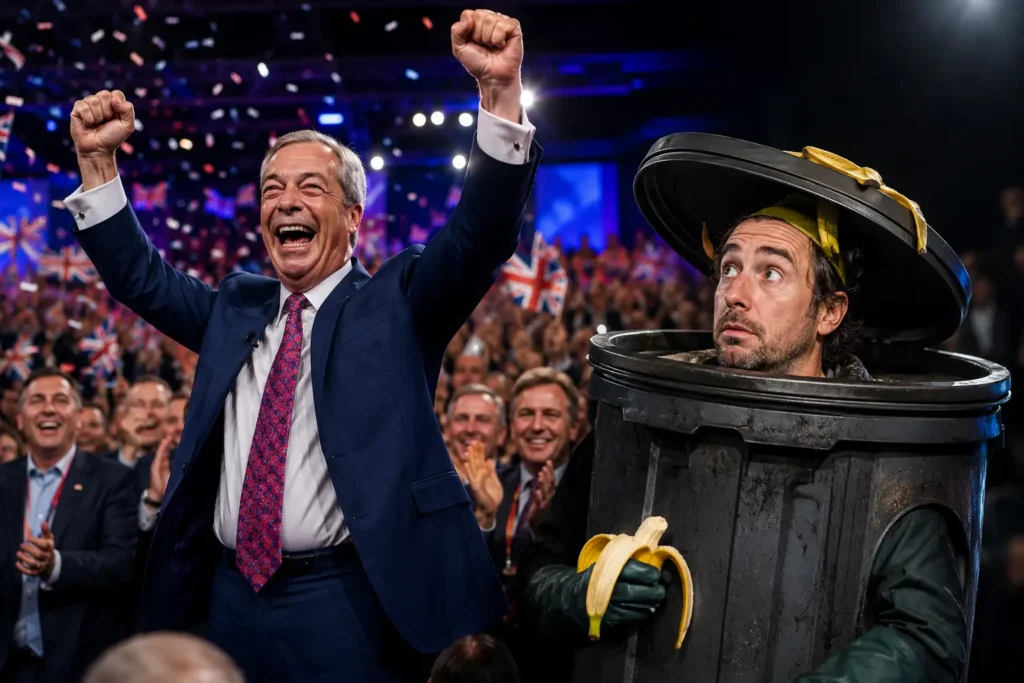
Reform UK leader Nigel Farage has reclaimed (regained, recovered, won back) his parliamentary seat on Friday, in an election he himself triggered (set off, initiated, brought about) in order to bolster (strengthen, reinforce, shore up) his standing against claims of financial impropriety (misconduct, wrongdoing, dishonesty). However, his plan was undermined (weakened, sabotaged, damaged) when his chief rival — a comedian dressed as a rubbish bin — took more than a quarter of the votes cast.
Farage, one of Britain’s most prominent Brexit campaigners, in an unusual departure (deviation, break, shift) from normal practice, did not attend the vote count in the seaside town of Clacton in southern England. He claimed police had warned him of a plot to disrupt (interfere with, obstruct, throw into disorder) the result.
“I am damned if I am going to stand on a stage, having won a resounding victory … and be demeaned (degraded, belittled, humiliated) and humiliated by nobodies,” Farage told his supporters at a party held before the results were made public.
The election came about after Farage stepped down from parliament last month, seeking a fresh mandate (authorisation, approval, sanction) from voters in what he called a battle against an establishment (ruling class, elite, power structure) determined to discredit (disgrace, undermine the reputation of, tarnish) him over undeclared gifts from donors.
Once Britain’s main political parties withdrew from the contest, dismissing it as a self-serving (self-interested, opportunistic, egotistical) stunt (publicity trick, gimmick, ploy), Farage’s principal opponent turned out to be Count Binface — a character invented by comedian Jonathan Harvey, who has become a well-known figure of light relief at British elections.
Farage secured 62.8 per cent of the vote, while Count Binface — whose manifesto included capping ice cream prices and conscripting (forcibly enlisting, drafting, recruiting) anyone caught using a speakerphone on public transport — won 26.7 per cent.
Reform’s Momentum Begins to Fade
Having enjoyed a long-standing lead in opinion polls, Reform’s popularity has begun to wane (decline, diminish, fade), partly due to the funding allegations (accusations, claims, charges) against Farage. He is currently under parliamentary investigation over whether he ought to have declared a £5 million ($6.75m) gift from a cryptocurrency billionaire.
After he described the Clacton election as little more than a ploy (scheme, tactic, manoeuvre) to divert attention from these allegations, other parties’ withdrawal left even some loyal supporters wondering whether the seasoned politician had been wrong-footed (caught off guard, outmanoeuvred, tripped up).
Laura Richards-Gray, a politics lecturer at Birkbeck University in London, observed that the absence of major-party rivals undermined (weakened, sabotaged, damaged) his attempt to frame the contest as “the people versus the establishment.”
“This has backfired (gone wrong, rebounded negatively, misfired), particularly on a national scale, as Farage lost control of the narrative (storyline, account, framing),” she said, adding that some voters regarded the election as “a waste of time and money.”
Farage’s standing has also suffered from rising support for the governing Labour Party. Since Andy Burnham became prime minister last month, Labour has enjoyed a bounce (surge, upswing, boost) in the ratings, now leading Reform 28 per cent to 25 per cent. Burnham has dominated (controlled, commanded, been at the forefront of) the airwaves and social media during his first weeks in office and, although the next general election is not expected for three years, he appears to be consolidating (strengthening, unifying, cementing) a left-leaning coalition around Labour.
Reform, meanwhile, finds itself competing for a divided (split, fragmented, fractured) right-wing vote, with both the Conservative Party and the anti-immigration party Restore Britain gaining ground.
The Billionaire’s Gift Under Scrutiny
Despite this electoral win, the parliamentary watchdog is expected to press on with its inquiry (investigation, probe, examination) into Farage’s financial declarations once he takes up his seat again. Central to the investigation is whether he should have disclosed the gift from a Thailand-based billionaire ahead of the 2024 general election.
Under parliamentary rules, MPs must declare any donations received in the year before an election within one month of taking office. Farage has admitted to receiving the money but not declaring it, insisting he has done nothing improper since it was a personal gift.
Should the investigating authorities determine that Farage breached (violated, broke, contravened) the declaration rules, he could face suspension (temporary removal, expulsion, exclusion) from parliament — and yet another vote to keep his seat, one in which the major parties would likely field candidates this time.