
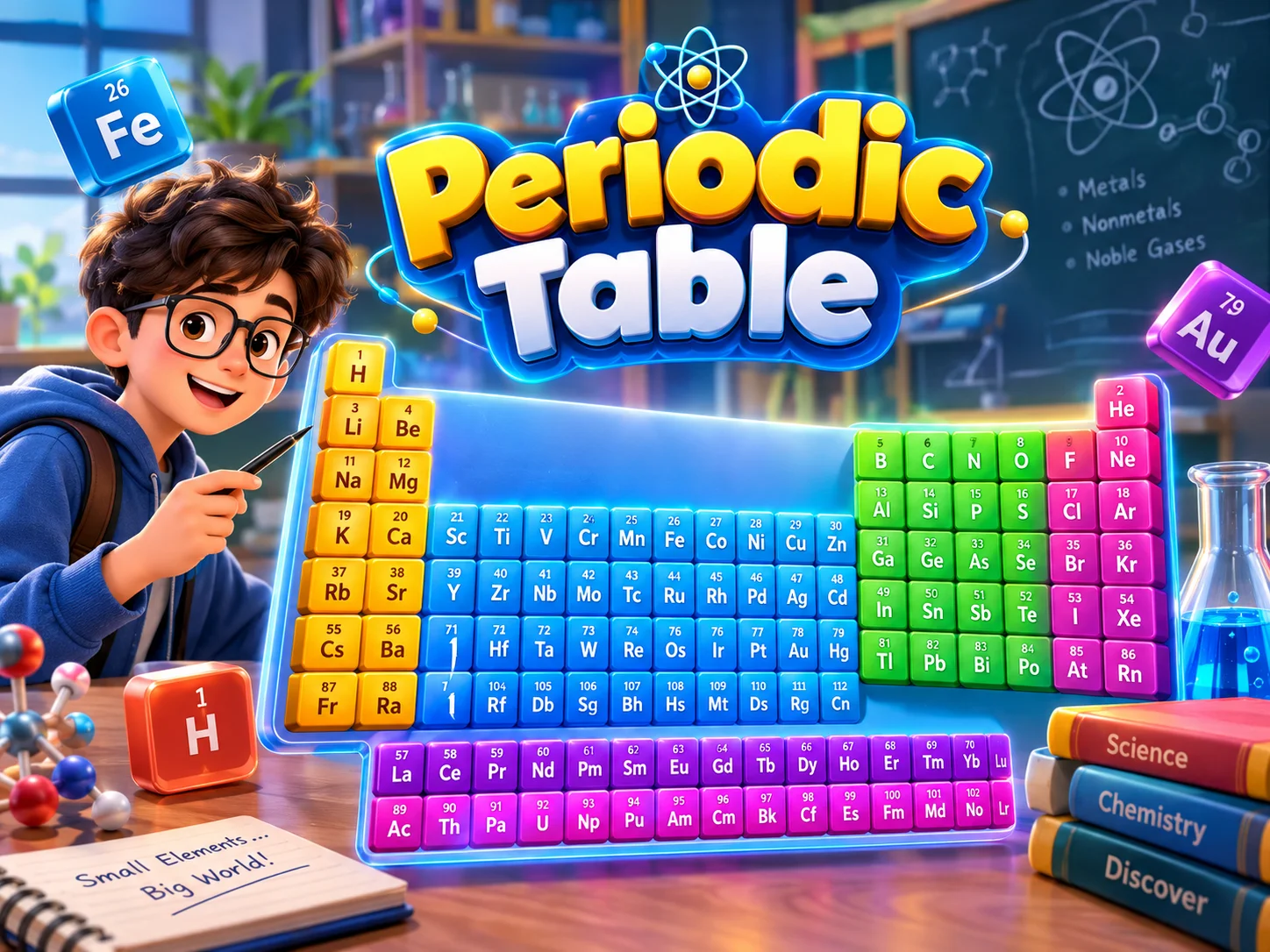
Periodic Table of Elements
Click any element to learn more
Categories
Element Details
Helium #2
Second lightest element, used in balloons and cryogenics. Inert noble gas.
4.003
Gas
Noble Gases
1868
1s²
Element Details
Lithium #3
Lightest metal, widely used in rechargeable batteries.
6.941
Solid
Alkali Metals
1817
[He] 2s¹
Element Details
Beryllium #4
Lightweight metal used in aerospace materials and X-ray windows.
9.012
Solid
Alkaline Earth
1798
[He] 2s²
Element Details
Fluorine #9
Most electronegative element. Used in toothpaste and Teflon.
18.998
Gas
Halogens
1886
[He] 2s² 2p⁵
Element Details
Neon #10
Noble gas famous for its use in bright neon signs.
20.18
Gas
Noble Gases
1898
[He] 2s² 2p⁶
Element Details
Sodium #11
Highly reactive metal. Essential nutrient found in table salt.
22.99
Solid
Alkali Metals
1807
[Ne] 3s¹
Element Details
Magnesium #12
Lightweight structural metal. Burns with a brilliant white flame.
24.305
Solid
Alkaline Earth
1755
[Ne] 3s²
Element Details
Aluminium #13
Most abundant metal in Earth’s crust. Widely used in packaging and transport.
26.982
Solid
Post-Transition
1825
[Ne] 3s² 3p¹
Element Details
Chlorine #17
Used in water purification and as a disinfectant.
35.45
Gas
Halogens
1774
[Ne] 3s² 3p⁵
Element Details
Argon #18
Third most abundant gas in the atmosphere. Used in welding.
39.948
Gas
Noble Gases
1894
[Ne] 3s² 3p⁶
Element Details
Potassium #19
Essential nutrient for cells. Reacts vigorously with water.
39.098
Solid
Alkali Metals
1807
[Ar] 4s¹
Element Details
Calcium #20
Essential for bones and teeth. Fifth most abundant element in the body.
40.078
Solid
Alkaline Earth
1808
[Ar] 4s²
Element Details
Scandium #21
Lightweight transition metal used in aerospace alloys.
44.956
Solid
Transition Metals
1879
[Ar] 3d¹ 4s²
Element Details
Titanium #22
Strong, corrosion-resistant metal used in implants and aircraft.
47.867
Solid
Transition Metals
1791
[Ar] 3d² 4s²
Element Details
Vanadium #23
Used to strengthen steel. Found in some mineral springs.
50.942
Solid
Transition Metals
1801
[Ar] 3d³ 4s²
Element Details
Chromium #24
Hard metal known for its shiny finish. Used in chrome plating.
51.996
Solid
Transition Metals
1797
[Ar] 3d⁵ 4s¹
Element Details
Manganese #25
Essential for steel production and enzyme function.
54.938
Solid
Transition Metals
1774
[Ar] 3d⁵ 4s²
Element Details
Iron #26
Most used metal worldwide. Core component of Earth’s core.
55.845
Solid
Transition Metals
Ancient
[Ar] 3d⁶ 4s²
Element Details
Cobalt #27
Used in blue pigments and rechargeable battery cathodes.
58.933
Solid
Transition Metals
1735
[Ar] 3d⁷ 4s²
Element Details
Nickel #28
Corrosion-resistant metal used in coins and stainless steel.
58.693
Solid
Transition Metals
1751
[Ar] 3d⁸ 4s²
Element Details
Copper #29
Excellent conductor used in electrical wiring since antiquity.
63.546
Solid
Transition Metals
Ancient
[Ar] 3d¹⁰ 4s¹
Element Details
Zinc #30
Used to galvanize steel and in batteries. Essential trace element.
65.38
Solid
Transition Metals
Ancient
[Ar] 3d¹⁰ 4s²
Element Details
Gallium #31
Melts near body temperature. Used in semiconductors and LEDs.
69.723
Solid
Post-Transition
1875
[Ar] 3d¹⁰ 4s² 4p¹
Element Details
Bromine #35
One of two elements liquid at room temperature. Used in flame retardants.
79.904
Liquid
Halogens
1826
[Ar] 3d¹⁰ 4s² 4p⁵
Element Details
Krypton #36
Noble gas used in photographic flash equipment and some fluorescent lamps.
83.798
Gas
Noble Gases
1898
[Ar] 3d¹⁰ 4s² 4p⁶
Element Details
Rubidium #37
Soft, highly reactive alkali metal. Used in atomic clocks.
85.468
Solid
Alkali Metals
1861
[Kr] 5s¹
Element Details
Strontium #38
Produces brilliant red flames. Used in fireworks and flares.
87.62
Solid
Alkaline Earth
1790
[Kr] 5s²
Element Details
Yttrium #39
Used in LEDs, lasers, and superconductors.
88.906
Solid
Transition Metals
1794
[Kr] 4d¹ 5s²
Element Details
Zirconium #40
Corrosion-resistant metal used in nuclear reactors.
91.224
Solid
Transition Metals
1789
[Kr] 4d² 5s²
Element Details
Niobium #41
Superconducting metal used in MRI magnets and particle accelerators.
92.906
Solid
Transition Metals
1801
[Kr] 4d⁴ 5s¹
Element Details
Molybdenum #42
High-melting-point metal used in steel alloys and catalysts.
95.95
Solid
Transition Metals
1781
[Kr] 4d⁵ 5s¹
Element Details
Technetium #43
First artificially produced element. Used in medical imaging.
98
Solid
Transition Metals
1937
[Kr] 4d⁵ 5s²
Element Details
Ruthenium #44
Rare transition metal used in electronics and as a catalyst.
101.07
Solid
Transition Metals
1844
[Kr] 4d⁷ 5s¹
Element Details
Rhodium #45
Extremely rare and valuable. Used in catalytic converters.
102.91
Solid
Transition Metals
1803
[Kr] 4d⁸ 5s¹
Element Details
Palladium #46
Precious metal used in catalytic converters and electronics.
106.42
Solid
Transition Metals
1803
[Kr] 4d¹⁰
Element Details
Silver #47
Best conductor of electricity. Used in jewelry and photography.
107.87
Solid
Transition Metals
Ancient
[Kr] 4d¹⁰ 5s¹
Element Details
Cadmium #48
Toxic heavy metal formerly used in batteries and pigments.
112.41
Solid
Transition Metals
1817
[Kr] 4d¹⁰ 5s²
Element Details
Indium #49
Soft metal used in touchscreens and LCD displays.
114.82
Solid
Post-Transition
1863
[Kr] 4d¹⁰ 5s² 5p¹
Element Details
Tin #50
Used since antiquity in bronze and tin cans.
118.71
Solid
Post-Transition
Ancient
[Kr] 4d¹⁰ 5s² 5p²
Element Details
Iodine #53
Essential for thyroid hormones. Used as a disinfectant.
126.9
Solid
Halogens
1811
[Kr] 4d¹⁰ 5s² 5p⁵
Element Details
Xenon #54
Noble gas used in flash lamps, ion propulsion, and anesthesia.
131.29
Gas
Noble Gases
1898
[Kr] 4d¹⁰ 5s² 5p⁶
Element Details
Cesium #55
Most electropositive stable element. Used in atomic clocks.
132.91
Solid
Alkali Metals
1860
[Xe] 6s¹
Element Details
Barium #56
Used in medical imaging (barium swallow) and fireworks.
137.33
Solid
Alkaline Earth
1808
[Xe] 6s²
Element Details
Lanthanum #57
First of the lanthanides. Used in camera lenses and catalysts.
138.91
Solid
Lanthanides
1839
[Xe] 5d¹ 6s²
Element Details
Cerium #58
Most abundant rare earth element. Used in catalytic converters.
140.12
Solid
Lanthanides
1803
[Xe] 4f¹ 5d¹ 6s²
Element Details
Praseodymium #59
Used in strong magnets and as a glass colorant.
140.91
Solid
Lanthanides
1885
[Xe] 4f³ 6s²
Element Details
Neodymium #60
Used in powerful permanent magnets found in headphones and motors.
144.24
Solid
Lanthanides
1885
[Xe] 4f⁴ 6s²
Element Details
Promethium #61
Radioactive rare earth used in luminous paint and atomic batteries.
145
Solid
Lanthanides
1945
[Xe] 4f⁵ 6s²
Element Details
Samarium #62
Used in samarium-cobalt magnets and cancer treatment.
150.36
Solid
Lanthanides
1879
[Xe] 4f⁶ 6s²
Element Details
Europium #63
Used in euro banknote anti-forgery phosphors and LED screens.
151.96
Solid
Lanthanides
1901
[Xe] 4f⁷ 6s²
Element Details
Gadolinium #64
Used as MRI contrast agent due to its magnetic properties.
157.25
Solid
Lanthanides
1880
[Xe] 4f⁷ 5d¹ 6s²
Element Details
Terbium #65
Used in green phosphors for displays and fluorescent lamps.
158.93
Solid
Lanthanides
1843
[Xe] 4f⁹ 6s²
Element Details
Dysprosium #66
Used in neodymium magnets and nuclear reactor control rods.
162.5
Solid
Lanthanides
1886
[Xe] 4f¹⁰ 6s²
Element Details
Holmium #67
Has the highest magnetic moment of any element. Used in lasers.
164.93
Solid
Lanthanides
1878
[Xe] 4f¹¹ 6s²
Element Details
Erbium #68
Used in fiber optic amplifiers and pink glass colorant.
167.26
Solid
Lanthanides
1842
[Xe] 4f¹² 6s²
Element Details
Thulium #69
Rarest lanthanide. Used in portable X-ray devices.
168.93
Solid
Lanthanides
1879
[Xe] 4f¹³ 6s²
Element Details
Ytterbium #70
Used in stress gauges, lasers, and atomic clocks.
173.05
Solid
Lanthanides
1878
[Xe] 4f¹⁴ 6s²
Element Details
Lutetium #71
Densest and hardest lanthanide. Used in PET scan detectors.
174.97
Solid
Lanthanides
1907
[Xe] 4f¹⁴ 5d¹ 6s²
Element Details
Hafnium #72
Used in nuclear reactor control rods and high-temperature alloys.
178.49
Solid
Transition Metals
1923
[Xe] 4f¹⁴ 5d² 6s²
Element Details
Tantalum #73
Highly corrosion-resistant. Used in electronic capacitors and surgical implants.
180.95
Solid
Transition Metals
1802
[Xe] 4f¹⁴ 5d³ 6s²
Element Details
Tungsten #74
Highest melting point of all elements. Used in light bulb filaments.
183.84
Solid
Transition Metals
1783
[Xe] 4f¹⁴ 5d⁴ 6s²
Element Details
Rhenium #75
One of the rarest elements. Used in jet engine superalloys.
186.21
Solid
Transition Metals
1925
[Xe] 4f¹⁴ 5d⁵ 6s²
Element Details
Osmium #76
Densest naturally occurring element. Used in fountain pen tips.
190.23
Solid
Transition Metals
1803
[Xe] 4f¹⁴ 5d⁶ 6s²
Element Details
Iridium #77
Most corrosion-resistant metal. Found in the K-Pg boundary layer.
192.22
Solid
Transition Metals
1803
[Xe] 4f¹⁴ 5d⁷ 6s²
Element Details
Platinum #78
Precious metal used in catalytic converters, jewelry, and chemotherapy.
195.08
Solid
Transition Metals
1735
[Xe] 4f¹⁴ 5d⁹ 6s¹
Element Details
Gold #79
Prized since antiquity for its beauty. Best conductor among metals after silver.
196.97
Solid
Transition Metals
Ancient
[Xe] 4f¹⁴ 5d¹⁰ 6s¹
Element Details
Mercury #80
Only metal liquid at room temperature. Formerly used in thermometers.
200.59
Liquid
Transition Metals
Ancient
[Xe] 4f¹⁴ 5d¹⁰ 6s²
Element Details
Thallium #81
Highly toxic metal formerly used in rat poison and insecticides.
204.38
Solid
Post-Transition
1861
[Xe] 4f¹⁴ 5d¹⁰ 6s² 6p¹
Element Details
Lead #82
Dense, toxic metal used in batteries and radiation shielding.
207.2
Solid
Post-Transition
Ancient
[Xe] 4f¹⁴ 5d¹⁰ 6s² 6p²
Element Details
Bismuth #83
Forms beautiful iridescent crystals. Used in medicines and cosmetics.
208.98
Solid
Post-Transition
1753
[Xe] 4f¹⁴ 5d¹⁰ 6s² 6p³
Element Details
Polonium #84
Highly radioactive. Discovered by Marie and Pierre Curie.
209
Solid
Post-Transition
1898
[Xe] 4f¹⁴ 5d¹⁰ 6s² 6p⁴
Element Details
Astatine #85
Rarest naturally occurring element. Radioactive halogen.
210
Solid
Halogens
1940
[Xe] 4f¹⁴ 5d¹⁰ 6s² 6p⁵
Element Details
Radon #86
Radioactive noble gas. Health hazard when accumulated indoors.
222
Gas
Noble Gases
1900
[Xe] 4f¹⁴ 5d¹⁰ 6s² 6p⁶
Element Details
Francium #87
Most unstable of the first 101 elements. Extremely radioactive alkali metal.
223
Solid
Alkali Metals
1939
[Rn] 7s¹
Element Details
Radium #88
Radioactive element discovered by Marie Curie. Formerly used in luminous paint.
226
Solid
Alkaline Earth
1898
[Rn] 7s²
Element Details
Actinium #89
Radioactive metal that glows blue in the dark.
227
Solid
Actinides
1899
[Rn] 6d¹ 7s²
Element Details
Thorium #90
Potential nuclear fuel. More abundant than uranium.
232.04
Solid
Actinides
1829
[Rn] 6d² 7s²
Element Details
Protactinium #91
Rare, radioactive actinide. One of the rarest natural elements.
231.04
Solid
Actinides
1913
[Rn] 5f² 6d¹ 7s²
Element Details
Uranium #92
Primary fuel for nuclear reactors and atomic weapons.
238.03
Solid
Actinides
1789
[Rn] 5f³ 6d¹ 7s²
Element Details
Neptunium #93
First transuranium element. Found in nuclear waste.
237
Solid
Actinides
1940
[Rn] 5f⁴ 6d¹ 7s²
Element Details
Plutonium #94
Used in nuclear weapons and spacecraft power sources.
244
Solid
Actinides
1940
[Rn] 5f⁶ 7s²
Element Details
Americium #95
Used in household smoke detectors.
243
Solid
Actinides
1944
[Rn] 5f⁷ 7s²
Element Details
Curium #96
Named after Marie and Pierre Curie. Used in space exploration.
247
Solid
Actinides
1944
[Rn] 5f⁷ 6d¹ 7s²
Element Details
Berkelium #97
Named after Berkeley, California. Produced in nuclear reactors.
247
Solid
Actinides
1949
[Rn] 5f⁹ 7s²
Element Details
Californium #98
Used as a neutron source for detecting gold and silver ores.
251
Solid
Actinides
1950
[Rn] 5f¹⁰ 7s²
Element Details
Einsteinium #99
Named after Albert Einstein. Discovered in nuclear fallout.
252
Solid
Actinides
1952
[Rn] 5f¹¹ 7s²
Element Details
Fermium #100
Named after Enrico Fermi. Created in thermonuclear explosions.
257
Solid
Actinides
1952
[Rn] 5f¹² 7s²
Element Details
Mendelevium #101
Named after Dmitri Mendeleev, creator of the periodic table.
258
Solid
Actinides
1955
[Rn] 5f¹³ 7s²
Element Details
Nobelium #102
Named after Alfred Nobel. Extremely radioactive synthetic element.
259
Solid
Actinides
1966
[Rn] 5f¹⁴ 7s²
Element Details
Lawrencium #103
Named after Ernest Lawrence, inventor of the cyclotron.
266
Solid
Actinides
1961
[Rn] 5f¹⁴ 7s² 7p¹
Element Details
Rutherfordium #104
Named after Ernest Rutherford. Highly radioactive synthetic element.
267
Solid
Transition Metals
1969
[Rn] 5f¹⁴ 6d² 7s²
Element Details
Dubnium #105
Named after Dubna, Russia. Short-lived synthetic element.
268
Solid
Transition Metals
1970
[Rn] 5f¹⁴ 6d³ 7s²
Element Details
Seaborgium #106
Named after Glenn Seaborg. Synthetic transactinide element.
269
Solid
Transition Metals
1974
[Rn] 5f¹⁴ 6d⁴ 7s²
Element Details
Bohrium #107
Named after Niels Bohr. Highly radioactive synthetic element.
270
Solid
Transition Metals
1981
[Rn] 5f¹⁴ 6d⁵ 7s²
Element Details
Hassium #108
Named after the German state of Hesse. Synthetic element.
277
Solid
Transition Metals
1984
[Rn] 5f¹⁴ 6d⁶ 7s²
Element Details
Meitnerium #109
Named after Lise Meitner. Properties not yet well characterized.
278
Solid
Unknown
1982
[Rn] 5f¹⁴ 6d⁷ 7s²
Element Details
Darmstadtium #110
Named after Darmstadt, Germany. Extremely short-lived.
281
Solid
Unknown
1994
[Rn] 5f¹⁴ 6d⁸ 7s²
Element Details
Roentgenium #111
Named after Wilhelm Röntgen, discoverer of X-rays.
282
Solid
Unknown
1994
[Rn] 5f¹⁴ 6d⁹ 7s²
Element Details
Copernicium #112
Named after Nicolaus Copernicus. May behave as a noble gas.
285
Solid
Unknown
1996
[Rn] 5f¹⁴ 6d¹⁰ 7s²
Element Details
Nihonium #113
Named after Japan (Nihon). First element discovered in Asia.
286
Solid
Unknown
2003
[Rn] 5f¹⁴ 6d¹⁰ 7s² 7p¹
Element Details
Flerovium #114
Named after Flerov Laboratory. May behave as a noble gas.
289
Solid
Unknown
1999
[Rn] 5f¹⁴ 6d¹⁰ 7s² 7p²
Element Details
Moscovium #115
Named after Moscow. Superheavy synthetic element.
290
Solid
Unknown
2003
[Rn] 5f¹⁴ 6d¹⁰ 7s² 7p³
Element Details
Livermorium #116
Named after Lawrence Livermore National Laboratory.
293
Solid
Unknown
2000
[Rn] 5f¹⁴ 6d¹⁰ 7s² 7p⁴
Element Details
Tennessine #117
Named after Tennessee. Second-heaviest known halogen.
294
Solid
Unknown
2010
[Rn] 5f¹⁴ 6d¹⁰ 7s² 7p⁵
Element Details
Oganesson #118
Heaviest known element. Named after Yuri Oganessian.
294
Solid
Unknown
2006
[Rn] 5f¹⁴ 6d¹⁰ 7s² 7p⁶